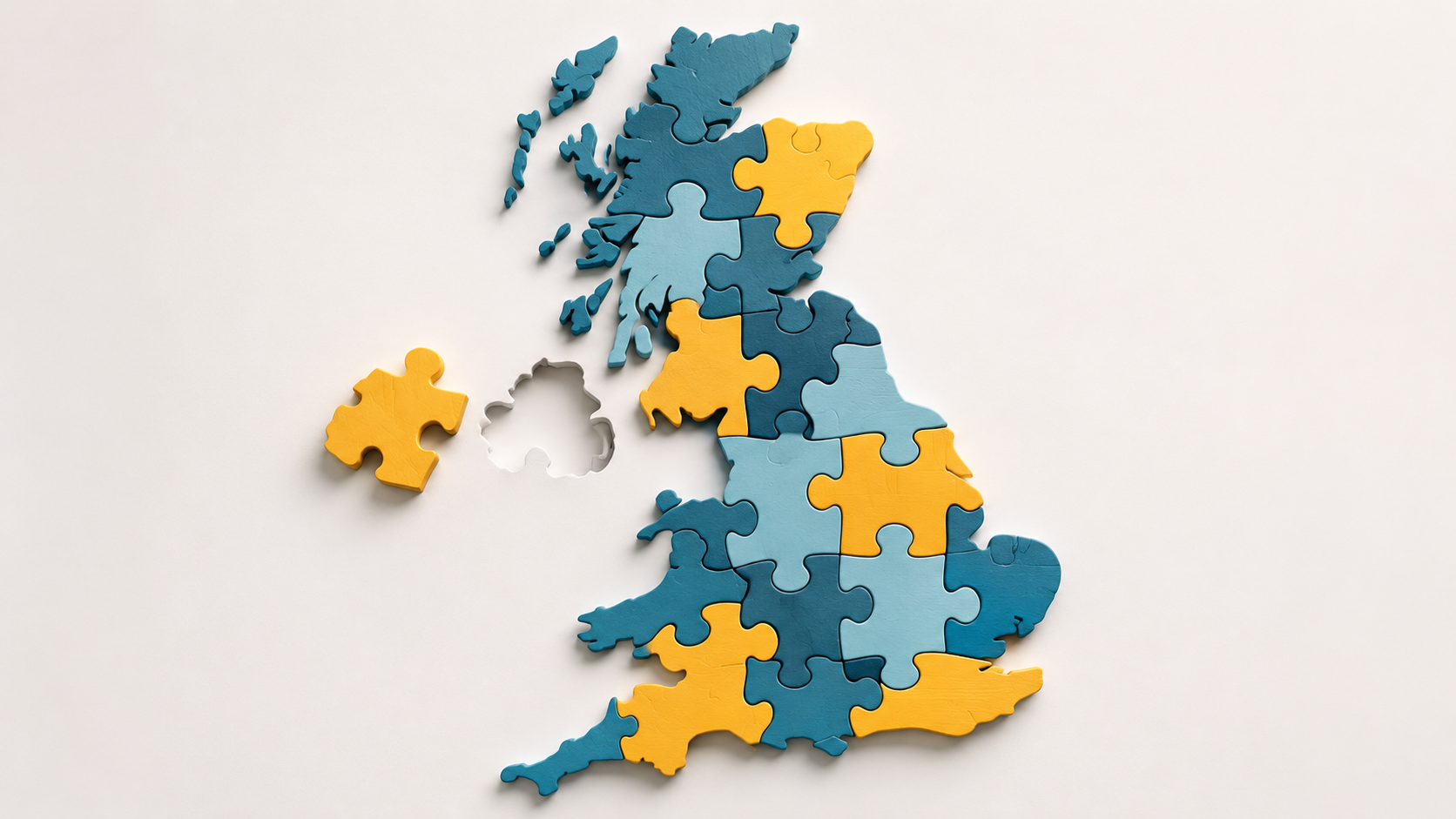
A nationally representative sample of 1,000 should give you about 28 people from Northern Ireland, which is already too few to report on its own.
The problem isn’t usually the sample size, but where the sample comes from. We’ve got used to fast and cheap sample via online surveys but achieving truly representative data means that sometimes we need a mixed method approach.
In our experience we see that most panel providers can have reduced coverage of some nations, in particular when the incidence rate drops below 30%.
We recently checked feasibility for a pet owner survey across the UK, including Northern Ireland. Incidence was estimated to be around 20%, and the target was 100 completes from N.I.
The three panels we checked couldn’t confidently reach 100 between them, only 96. And typically, we’d say that the likely response fromthat reach would be around half, maybe two-thirds. Part of the gap is profiling. Plenty of panellists will have pets but have never told their panel. You can find them by screening the wider panel, but that takes longer and pushes the incidence down further.
Why a proportional sample doesn’t fix it.
Here’s how the margin of error grows as the number of people falls (95% confidence, on a 50% result):
Responses from N.I.
Margin of error
28 (±19 points)
100 (±10 points)
1,000 (±3 points)
With 28 responses, a 50% result could really be anywherefrom 31% to 69%. That isn’t a finding you can put in front of a client.
A boost sample fixes this, but it costs more and takes longer, especially in Northern Ireland.
So, what can you do to ensure that your sample is optimised?
1) Decide if you need results per nation. If you only need a UK total, a proportional sample will be fine however where you need to report separately, plan for at least 100 per nation.
2) Check feasibility for eachnation, not just the UK. Ask panels how many panellists in each national actually fit your criteria. A blended UK count can hide a low count in devolved nations.
3) Use more than one source: combine several panels and add in face to face or phone interviews where coverage is low.
4) Plan the back up at thestart; agree a contingency for if devolved nations fall short of targets; longer fieldwork, a reduce target, or mixed method top up.
5) Check the questionnaire works outside England: Prescriptions are free in Scotland, Wales and Northern Ireland. Water bills work differently in Scotland and Northern Ireland. School qualifications are different in Scotland. A question that assumes English rules get the wrong answers and can cause drop out.
6) Offer Welsh in Wales; Welsh language use is increasing, and public sector clients often require a Welsh version. Flag this for scripting and timelines early, so that English doesn’t become default.
Are you planning research that needs to hold up in Scotland, Wales or Northern Ireland?
Send us the brief and we'll tell you where the sample will run thin before you're committed to it.